What Twenty Conversations Have Taught Me About Narrative Intelligence
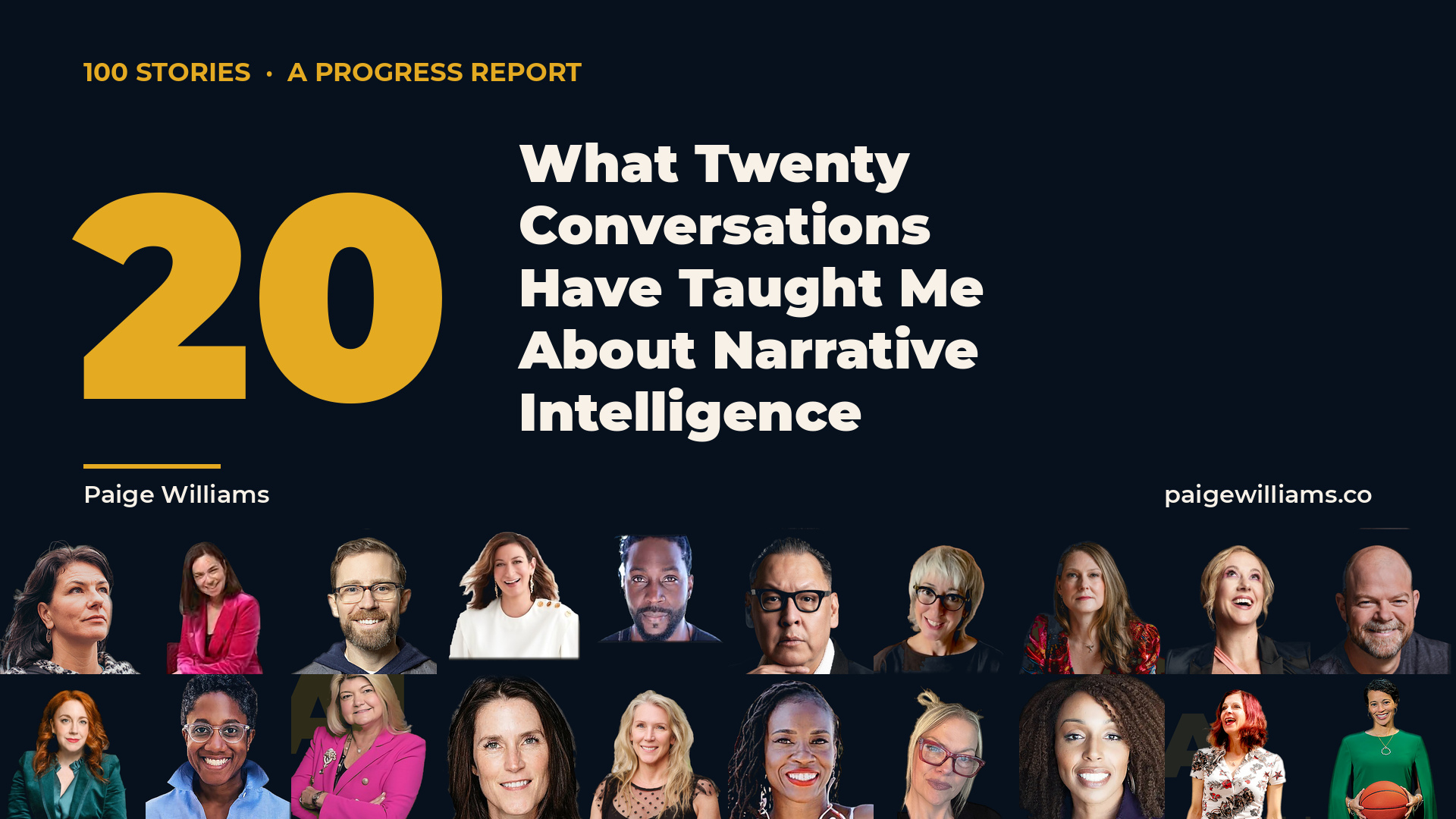
Twenty conversations in, the framework that has taken shape through them has been complicated as often as it has been confirmed. This is a progress report, not a conclusion.
By Paige Williams — applied researcher and strategist developing a Narrative Intelligence framework.
Why write this now
Twenty conversations in, the framework that has taken shape through them has been complicated as often as it has been confirmed. I want to say so now, before hindsight smooths the story over.
When I began 100 Stories, the question was simple to ask and hard to answer: how much can the stories we live by change, and what does it take to change one? I did not walk into those conversations with a finished framework. I had the question, a few early hunches about what this capacity might involve, and a rule that what guests said would shape the rest. The five capacities I describe below took their present form through the conversations. That is the difference between a theory and a framework. A theory proposes an explanation. A framework gives you a structure for looking. At this stage, I am building the latter, and this one was drawn while I was looking. Twenty guests have now looked back at me, and what they said has complicated the map more than it has confirmed it.
This is a progress report, not a conclusion. Twenty is a fifth of the way. I am writing it because the conversations have started to say things I did not expect, and because the honest thing to do with a framework still in progress is to let the evidence bend it in public. Everything that follows comes from what guests actually said, in their own words, or from my own research. Where I am guessing, I say so.
The framework, in plain words
Narrative intelligence, as I am proposing it, is the human ability to notice the stories shaping our experience, to sort what is true in them from what we are assuming, and to change how we relate to them. I break that ability into five parts. When I teach them, I give each one a verb.
SEE · Recognition — Makes a narrative visible, creating room between the story and the person living it. The question it asks: “What narrative is shaping how I see this?”
SORT · Discernment — Separates what is actually true from assumption, interpretation, inheritance, or projection. The question it asks: “What is actually true, and what am I interpreting?”
EXPAND · Flexibility — Opens to other plausible meanings, perspectives, or possibilities. The question it asks: “What else could this mean?”
CHOOSE · Agency — Locates where meaningful choice exists and decides how to respond. The question it asks: “Given what I know, what do I choose?”
LIVE · Enactment — Turns the choice into how a person actually acts, relates, decides, or lives. The question it asks: “What would that choice look like in how I actually live?”
Three things about this table have held up under pressure. One has not.
The five are capacities, not steps. I teach them in the order SEE, SORT, EXPAND, CHOOSE, LIVE because that is the easiest way to learn them. That is all the order means. Real people do not move through them in sequence, and some of the strongest moments in these conversations run backwards.
Narrative intelligence does not mean rewriting your story. Accepting a story, refusing one, questioning it, holding it more loosely, or realizing it is simply accurate can all be narratively intelligent. I say this early because the culture around storytelling assumes the smart thing to do with a story is change it. Twenty conversations have made me more doubtful of that, not less.
Compassion sits underneath all five. It is the stance you practice them from. It is not a sixth capacity.
What has not held up is my early assumption that these capacities develop, and can be measured, inside one person alone. That is the subject of the second finding below, and it is the most serious thing these conversations have said to me so far.
1. We are inheritors of narrative
Recognition, the capacity I put first, works on material we did not write. The stories come to us before we can see them, and so does the equipment for seeing them.
Nobody in these conversations chose the first story they lived inside. Eyoälha Baker's name means the wind, in a language her grandmother was forbidden to speak at residential school, and it has shaped how she moves through the world since before she could think about it. Joseph Grady was born during the era of the Indian Adoption Project. Casey Erin Clark absorbed the message that a human being is bad from the church pews long before she was old enough to question it. Teneia Sanders grew up hearing that people from Mississippi are not smart enough. Ara Tucker's parents raised her on lessons from their own lives that they never said out loud. For each of them, Recognition started with noticing something they had inherited, and the inheritance was already at work.
Quentin Robinson teaches hip hop dance history and runs a movement program. He told me about a student who could spell the word compassion and had no gesture for it. Not no word. No gesture. Quentin's name for what that student was missing is "the library": the store of lived experience, held in the body, that gives you the clues to understand a story you did not write. You read a new story against your library. If the library has no entry for it, the story goes unread.
I had been treating Recognition as something like paying attention, a matter of looking harder. Quentin's library says otherwise. Recognition depends on what you have already lived, and some people have been given more to draw on than others. That complicates the framework, and I have chosen to leave the complication visible rather than tidy it away.
Cheri Williams took the same idea up a level. Her version is that sometimes you have to recognize the institution's story before you can recognize your own.
Ara Tucker, whose work rests on the idea that all of our advantages can be architected, described the same thing from inside a fortunate life. Her mother made her learn to read the summer before kindergarten, took her to take-your-daughters-to-work day before it was take-your-kids, and brought her on business trips around the world. Her father built an art business she grew up inside. She did not see any of that as advantage until her wife told her, plainly, that she was a nepo baby. Her account of what early exposure does is the clearest I have heard: exposure becomes fluency, fluency becomes ease, ease gets read as talent, and talent gets rewarded. The library is not only what lets you read a story. It is what other people mistake for your gifts.
What these conversations add is a limit. Recognition is a capacity, but it works on things we inherited: the stories themselves, handed down by family, culture, and institutions, and the library that lets us read them, built from experience and circumstance. We chose neither. A framework that scores Recognition without asking what a person inherited will end up measuring their circumstances and calling it their skill.
How deep the inheritance goes is a question I cannot answer from interviews. Guests describe stories arriving through language, family, and place, and a few of them, Eyoälha and Joseph most directly, speak of inheritances older than anything they were told. Whether any of that lives in the body in ways science can trace is a question for epigeneticists and geneticists, and it is one of the conversations I most want to have in the next eighty. I am not making that claim here. I am marking where it would go.
2. The conditions for narrative intelligence are relational
The most serious challenge to the framework so far came from a friendly expert, and it came as a story about listening.
Thaler Pekar has spent two decades helping organizations share stories rather than just tell them. Her vocabulary is her own and I am keeping it that way: the Narrative Garden, story sharing, continuity stories, heart, head, and hand. She has recorded 178 oral histories across six countries. Then she said the thing that has stayed with me. You can only listen because someone once listened to you. Someone has to go first.
If Thaler is right, then the ability to listen develops in relationship. You learn to listen because someone listened to you first. You learn to hold a story because someone once held yours. The capacity may be your own, but the conditions for developing it were not. That creates a problem for measurement. If I score a person's narrative intelligence, some of what I am scoring is what the people around them made possible, and not only what the person can do. It is the strongest objection to my assessment on the record, and it stays there.
Ann Shoket came at the same idea from a different direction. She built a career on the idea that success is a team sport, and she is clear about how a person comes to see their own story at all. The raw material comes from outside, at the moments when someone else's life turns out to be different from what you thought was possible. You do not figure out that a different life is possible by thinking hard. You figure it out because someone in the room is living it, and their story does not match yours.
Michael Osbourne, who has produced podcasts for twenty years and listens to fifteen hours of tape a week, was the most direct about how little we can see on our own. His own turning point came from a stranger. A career counselor named Diane, at what he calls the last stop before the therapist's office, asked him out of nowhere whether he had ever thought about starting a podcast. He has been trying to thank her ever since. His conclusion is that the ego tells an incomplete story, sometimes flattering, just as often brutal, and that he is not the best judge of his own. He needs other people to watch how he acts and tell him whether the version in his head is true. A friend of his, Corey Best, gave him the question he now asks whenever the voice of self-judgment gets loud: who told you that story, and how did it get in there?
Not every guest agrees. Teneia Sanders, asked where her courage to be seen came from, said she did not think anybody gave it to her. People encouraged her, but the fire felt like her own wiring, part of what her soul arrived with. I am keeping her disagreement on the record. If narrative intelligence develops in relationship, Teneia is a reminder that the framework has to leave room for what people bring with them.
Each of them is saying the same thing: we see our own story because of other people. Someone listened to us. Someone lived a life we did not know was possible. Someone asked a question we could not have asked ourselves. When I first drew the framework, I put the individual in the middle with the people and systems around them, as if a person sees first and then reaches out. These conversations suggest it often works the other way around. Other people come first, and seeing follows. The cleanest way I can say it now is this: the capacities are personal, but the conditions for them are not. If that is right, then measuring one person on their own may be starting in the wrong place.
3. The body is a route, not only a store
The framework asks you to examine at every point, and it has never treated understanding as a step that has to come before action. But most of the language we have for changing a story, mine included, tends to put the mind first: see the story, then do something about it. Four guests who work below the level of words showed me that the examining can start in the body, and sometimes it has to.
Julie Fogh is a voice and presence coach. She describes the nervous system as holding your old story the way an AI model holds its training data: it can only predict what comes next from what it has already seen. That is why change feels like threat in the body. The system is doing exactly what it was built to do with the only information it has. You start to hear the old story when it stops fitting. And because the story lives in the breath, changing the breath changes the story. There is a way into Recognition through the body that does not go through insight at all.
I want to be careful here. Julie's account is a practitioner's account, not a clinical finding, and I am reporting it as hers. But it explains something the framework could not: why a person can see a pattern clearly and keep doing it anyway. If the story is held somewhere below where seeing happens, seeing is not enough.
Quentin gave me the other half. In Afghanistan, arguing directly against an inherited prejudice, with evidence, did not move it. A shared dance floor did. Nothing was argued. Two bodies moved together, and a story that had survived argument did not survive that. In Fort Lauderdale, dance worked as a physical credential, a way into a neighborhood that no words could have opened.
Casey Erin Clark, who co-founded Vital Voice Training with Julie, works the same route through the voice. She believes every human being can sing and should, because singing is one of the most primal things a body does, as primal as eating, and one of the most direct ways to connect with vibration and with what she calls the you-ness of you. Your voice, she says, contains everything that makes you who you are. So when a client discovers a sound they did not know was in them, the discovery is not an idea. It happens in the throat and the chest before it happens in the mind, and what she sees on their face in that moment is light coming out through their pores. That, she says, gets imprinted.
Angie Lipski, an architect of thirty years, widened the body's route to include the room it is standing in. Her belief that our bodies understand a place before our minds do came, she says, from plain reality: walk into a school with stale air and peeling paint and you know before you think. A place holds a story, usually one built on the values of the people who made it, and the places we live in become the memories that become the markers by which we tell our lives. She is clear about the limit. She can put you in the most beautiful space and touch every sense the right way, and if you are not willing to change, she cannot make you. The built world gives cues. Whether a person steps into them is up to the person.
What these conversations add is a second door into the framework. Recognition and Enactment are separate capacities, and I still think they are. But the body appears to be a place where they meet, and where the order I teach can be entered from the end.
4. Seeing the story is not the same as living differently
The question at the heart of my sample chapter is why a person can see a pattern clearly and keep doing it anyway. Several guests answered it from inside their own lives, and their answers point the same way: insight comes late, and evidence comes first.
Monica Lebron spent twenty-seven years in college athletics and wore being a workaholic as a badge of honor. She did not see it as a story until she was kicked off the hamster wheel, and she is clear she would never have kicked herself off. Her sentence for what she saw from the sideline is that work didn't love me back. When I asked whether she could live that knowledge inside a high-pressure job again, she gave me the most honest answer in these conversations: I won't know until I'm in it. She can see the pattern. She knows what she wants to do differently. And she refuses to claim the change before the old rewards and pressures have tested it.
Courtney Townley, who has coached thousands of midlife women, put the pieces in order. Recognition almost always arrives through pain, what she calls integrity pain, the friction of living against what you know. People have different thresholds for it. Some tap the brick wall once, most hit it several times, and some have to be nearly hospitalized. Then comes what she calls, without apology, the shit moment: the reckoning when a woman hears herself say that she is creating her own suffering and refusing to change it at the same time. What follows is small steps, and here Courtney said something that reorders my framework. Before we have evidence, it is hard to change a story. The new story gets lived in tiny pieces until there is enough proof to believe it, and only then does it get told.
Teneia Sanders wrote a love song to herself after her divorce, when she was in enough pain that the song and her life did not yet match. It was, she says, who she wanted to become. Now, she says, I live in the story. The song came first. The living caught up.
Casey Erin Clark sees the same order in her studio. Sometimes it takes someone else's words, a Shakespeare monologue, a Shonda Rhimes mic-drop speech, for a quiet person to discover that a loud sound was in them the whole time. You cannot argue someone into that. They have to hear it come out of their own body, and Casey says they do not forget it once they have.
Ara Tucker, who has left a law firm, a university, and the chief people officer track to build her own work, says it in one line to every woman standing in the hallway: you aren't going to be ready until you're doing it, because doing it is how you get ready. Michael Osbourne adds the condition. A person has to be shown the truth of themselves and be able to look at it, and he warns against underestimating the power of denial. Both halves are required. Circumstances sometimes supply the first. Only the person can supply the second.
What these guests add is a correction to the order I teach in. SEE, SORT, EXPAND, CHOOSE, LIVE is how I explain the capacities. On this evidence it is rarely how change actually happens. Often a person lives a little differently first, gathers proof, and only then can see and believe the new story. Courtney's phrase for the whole practice is parenting your brain, and her claim that the skills can be taught, that there is nothing wrong with you and you are only missing an ingredient, is the most hopeful thing anyone has said about whether narrative intelligence can be developed. I am recording it as a claim I intend to test.
5. Change moves one sentence at a time
When change shows up in these conversations, it rarely arrives as a transformation. It arrives as a sentence, and the sentence is usually small.
Matt Anderson gave me the phrase "values fatigue" for the slow weight of a gap between what he believed and what he was doing for a living. He felt it for years before it had a name. Once it had one, things moved fast: a Sunday conversation, a Monday journal entry, and he was gone in six weeks. Naming did not cause the change. It seems to have released a change that was already loaded. His own summary is that our lives change one sentence at a time, and his example is a young man named Cody asking him, "You probably don't even know my story, do you?" That sentence became a documentary and, eventually, a career.
Lindsay Scola lived nineteen years with undiagnosed narcolepsy before her diagnosis at thirty-five. What I could trace in her account was a series of inner sentences, each replacing the last. "I messed this up" became, over years, "there is a reason." The grief inside that shift is real, and she did not skip it. The diagnosis did not rewrite her story. It gave her a sentence she could finally say out loud.
And saying it out loud turned out to be part of how the change worked. Lindsay's new story did not settle until she told it publicly, to people who needed to hear it, and became the adult she had needed at sixteen. Some changes, these conversations suggest, only finish when they are spoken to someone they matter to.
The framework had treated Recognition as something that happens inside your head. Matt and Lindsay suggest it often happens out loud, and that the sentence is the unit of change, not the whole story.
6. The intelligent move is often to leave the story alone
The conversations that changed my thinking the most are the ones where nothing got rewritten.
Lynn Harris works in comedy and culture change, and she has no patience for the pressure to make every story mean something. Her line was that not every story has to have a silver lining, and that you can let yourself off the hook for making it mean something. That lands hard, because the whole storytelling business, mine included, runs on the idea that a story is not finished until it has been redeemed. Lynn's view is that some stories are finished when they are simply told accurately. The narratively intelligent move there is refusal: refusing the arc.
Thaler offered a quieter version. She has told the same story about a Hoboken waterfront vote, decided by twelve votes in 1990, for more than thirty years. The story never changes and never stops getting deeper. She keeps finding new ways into it. I had defined Flexibility as being open to other meanings, and I still do, but Thaler's practice adds something I had not named: re-entry, the ability to keep finding new doors into a story you go on telling, rather than swapping it for a new one.
Joseph Grady's story runs in yet another direction. A Blackfeet filmmaker and social worker born during the era of the Indian Adoption Project, he made a film called Return to the Blanket about something that had already happened to him. What a later trip to the Dakotas gave him was not a new story but a way to understand the one he had lived. The events did not change. What changed was that they made sense. That is Recognition arriving after the fact, and it is one of the clearest cases in these conversations of a story being reclaimed rather than rewritten.
Eyoälha Baker, my first guest, gave me the plainest case of refusal. She had been living in a tent on healing retreat land during the pandemic, with a storyline of her own. When she went back to a city and a family watching the news, the fear started to take hold, and she decided not to believe it. She sold amethysts for airfare, called every government line, got no answer, and crossed the border anyway, counting eagles the whole way down. Her grandmother held the eagle seat in the family's potlatch lineage, and I leave her way of seeing it intact. What matters for the framework is the decision, made against a story everyone around her was living inside.
Teneia Sanders laid down a dream rather than a story: the stage, the crowds, the tours. She got all of it, and her account is that it was not what it looked like, it was what it felt like, and what it felt like was empty. Her phrase is that she put her artist in time out. She also gave me the clearest example of interpretation I have collected. She and I looked at the same tarot card and read it two ways, as an ending and as an opening, and neither reading was in the card.
Taken together, these guests add a category the framework needed. Besides rewriting a story, you can refuse its arc, refuse the story outright, re-enter it, lay it down, or finally read it. All of these are intelligent. None of them changes a word.
7. Systems have stories too, and different tools work on them
I expected the hardest thing to hear about would be the stories of systems, because institutions do not sit for interviews. Instead this has been some of the most useful material so far.
Matt Anderson and I arrived together at what he calls the "what if" question, and by the end of the conversation we had worked out what makes one work. It has to reveal a problem. It has to imply a solution. It has to be simple, it has to be an invitation, and it has to be sticky enough that people who dismiss it cannot forget it. His two examples: what if we reforested Haiti, and what if termination of parental rights no longer existed. This is a narrative tool in the plainest sense, and it is what Enactment looks like at the scale of a system. His bridge back to the individual is that systems reflect us, so fair structures have to start with people.
Nichelle Carr said the thing about institutions I now cannot unhear. Speaking of a country and its history, she said it has to stop telling the stories it loves most about itself. Her way of describing critical race theory was that it offers a story where you do not have to be the bad guy. That reframe, offered as an invitation rather than a verdict, is what Flexibility looks like at the level of a system, and she delivered it while gently correcting something imprecise I had said. The correction fed straight into her definition of narrative intelligence. It was the most narratively intelligent moment in the series so far, and it happened live.
Cheri Williams added a point about who does this work: people from hard places have to be reframers to survive. Reframing, in her account, is not a skill you pick up in a workshop. It is a survival adaptation, demanded of some people more than others and rewarded unevenly.
Whitney Williams, who has run for governor and produced documentaries, brought a stubborn, working optimism: progress is possible, and the proof is a genius on every block. She described narrative intelligence in terms of attention, what a community chooses to look at.
Casey Erin Clark named the institutional level directly. She grew up inside two big stories at once, the story of what it means to be a Christian and the story of what it means to be a real artist in the theater world, and she describes both as mostly unexamined and enormously powerful. Her question is the useful one: what is my story within that institutional story, and do I need to take it outside? Of the evangelical message that a human being is bad, she says she had to burn it to the ground. She also noticed that her church taught storytelling as testimony, a story told to convert someone, and that a story with that goal changes every relationship it enters.
Ara Tucker drew the line the framework most needed here. We can all write our own stories; there is no barrier to imagination. But stories do not all get the same permanence, the same reach, or the same volume, and every storyteller needs a megaphone that is usually not their own. Her point is that the hardest stories to change are the ones running in the background, the ones nobody has named, and that a system's background stories decide whose voice carries. Narrative intelligence, in her view, cannot only be about personal agency. It has to include awareness of the conditions that let some stories be heard and not others.
What this adds is a reminder that the five capacities do not scale up automatically. At the level of systems, Recognition looks like stewardship, Flexibility looks like an offered way out of being the villain, and Enactment looks like a question sticky enough to survive being dismissed. The verbs hold. The practices are their own.
8. Why AI makes this urgent without making it the point
Artificial intelligence is not what narrative intelligence is built on. It is the reason we have less time.
Sandy Carter has spent a career inside technology, and her view of AI is cautious. What you tell an AI system stays there. You cannot take it back. Her bigger point is that judgment has not been digitized: the part of narrative intelligence that decides what a story means and what to do about it has not been automated, and she does not think it should be handed over. Her advice was blunt. Think before you tell AI your story.
Nichelle Carr, who works in craft and culture, had the sharpest description of what these systems produce. A photocopy of a photocopy. Bad facts, delivered fluently. And her plainest sentence: it is generating text. That is what it is doing. She was not dismissing the tools. She was insisting that the capacities in this framework, SEE and SORT above all, are exactly what a person needs in a world where fluent text is cheap and accuracy is not.
Eyoälha Baker ran into the limit before either of them. Researching her own birth story, she asked an AI system about a doctor known in her community for harming Indigenous children, and it gave her back a hero, because the written record was the colonial one. Three times she asked for the Indigenous perspective. It could not do it. Her conclusion is that if it has not been written down, it does not exist for the machine, and her definition of narrative intelligence follows from that: remembering that cultural perspectives do not always translate.
My own work with Dr. David Firth on governing narratives and how organizations adopt generative AI points the same way, though I will not claim more than a study in progress can show. What these conversations add is a change in why this matters. I started this project because I believed narrative intelligence was important. Twenty conversations in, I believe it is becoming a basic literacy, because the stories now arriving in people's lives are being produced at a volume and fluency no earlier generation had to sort through.
Where the conversations pushed back
A framework that only ever gets confirmed is not being tested. Here is what has not gone my way.
Measurement. Thaler's point about listening and Quentin's library say the same thing from different rooms: a person's score may be recording their environment as much as themselves. My assessment, the Narrative Quotient, is in its second design, and I have not solved this. For now I am naming it as a limit rather than designing around it, and treating Enactment in particular as skill under constraint rather than achieved outcome, so that a person facing real barriers is not scored as if they lacked the capacity.
Application. I once taught narrative intelligence to a room of mid-level corporate marketers and it did not land. I said so in the interview with Julie Fogh, and she explained why that channel does not work: much of what people listen to now comes through a mask, with the nuance controlled out of the voice. I kept it in the essay because the failure belongs on the record.
Selection. Guests are people who already believe stories matter. Ann's community, Julie's clients, Thaler's storytellers all arrived already convinced this work helps. These conversations are not a sample of humanity. They are a sample of people who said yes to a podcast about narrative.
Relationships. I have known several guests for years. Matt and I made a film together over three years. Quentin is a friend, and so is Angie Lipski, who designed the house across the alley from mine. Joseph's film won a prize on the platform I founded, and he told me on tape that the recognition validated his work when he needed it. In each case I disclosed the relationship, because a reader who does not know that I supplied much of the framing in the Matt interview, or that my platform gave Joseph's film legitimacy, cannot weigh what they are reading.
The earlier meaning. Michael Mateas and Phoebe Sengers used "narrative intelligence" in 1999 and 2003 for a research program in AI and cognitive science. I am using the words differently, and I say so wherever the term appears, because a reader who knows that history will otherwise assume I do not.
What I am carrying into the next eighty
The framework has moved in three ways since episode one, and I want to write the moves down before they start to feel obvious.
The five capacities have held. No guest has given me a reason to add a sixth or drop one, and I have a rule against doing either on the strength of a single interview. What has changed is the ground they stand on. Recognition works on stories we inherited before we could see them, and draws on a library that is unevenly supplied. We learn to listen because we were listened to. The body offers a door that insight does not. None of that changes the verbs. All of it changes where I look for them.
The individual is no longer the default unit. I drew the framework with a person at the center and their relationships and systems around them. These conversations keep pointing outward: to the room where someone else's story turned out to be different, to the institution whose story had to be seen first, to the dance floor where two bodies did what argument could not. My working hypothesis now is that the capacities are personal but the conditions for them are not, and the research is built around that. Five proposed capacities crossed with four conditions: body, identity, culture, and power. Every cell is a question. None is filled in. Ara Tucker's phrase for the last condition is the architecture of advantage, and it is the closest anyone has come to describing what one of those cells would hold.
Rewriting is one move among several. Refusing an arc, re-entering a story, and reading an old story for the first time are all intelligent, and the framework now says so up front rather than in the footnotes.
One more thing has moved, and it is me. Every one of these interviews has changed me. Each one has taught me something about the part of narrative intelligence I had underrated, which is listening. Not listening for the quote, or for the moment that will make the episode, but listening for the story a person is living inside while they talk. Twenty conversations in, I cannot turn it off. I am seeing people's beliefs and behaviors, and especially my own, through the lens of narrative meaning. I hear the sentence someone chose and the one they avoided. I catch myself mid-story, reaching for the version that makes me look better, or the one that lets me off the hook. It is maddening and fascinating at the same time, and I suspect it is what the framework feels like from the inside.
What I still do not know is what is actually inherited and by what route, whether any of this can be measured without measuring circumstance, whether it can be taught to people who did not ask to learn it, whether the sentence really is the unit of change or only the unit I can hear, and whether the word intelligence carries a moral claim. We would never call a demagogue narratively intelligent, and yet demagogues know how to use story. Casey Erin Clark added a complication from the theater: every act of communication wants something, and having an objective is part of speaking at all. The line she draws is at the goal, the testimony told only to convert. Compassion already sits beneath the five capacities. Whether it belongs inside the definition is a question I did not expect and cannot yet answer. Eighty conversations remain. If the first twenty are any guide, the framework will be more complicated at the end than it is now, and better for it.
A theory proposes an explanation. A framework gives you a structure for looking.
Continue
More research notes.
100 Stories Insights
What Does It Really Take to Change the Stories We Live By?
A progress report from 100 Stories, episodes 21–30: why the assessment no longer gives a number, what ten more guests did to the framework, and the question now at its center.
Story Awareness
The story choosing for you
Why awareness—not better storytelling—is the first capacity of Narrative Intelligence.
Listen & Watch
100 Stories
Join the conversations exploring story, identity, and human agency.
Subscribe, follow along, and share a conversation that resonates with you.