What Does It Really Take to Change the Stories We Live By?
Ten conversations ago I had an assessment that gave people a number. I no longer do. The five proposed capacities survived these ten conversations. The way I hold them did not.
By Paige Williams — applied researcher and strategist developing a Narrative Intelligence framework.
Thirty in
Ten conversations ago I had an assessment that gave people a number. I no longer do. That is the single biggest change in this stretch of 100 Stories, and it happened on tape, in the middle of episode 25, when I asked Stanford mathematics educator Jo Boaler whether something as complex as narrative intelligence should be reduced to a number. I had built the assessment to help people see their relationship to the stories shaping their lives. Her answer made me ask whether I was handing them one more fixed story about who they were.
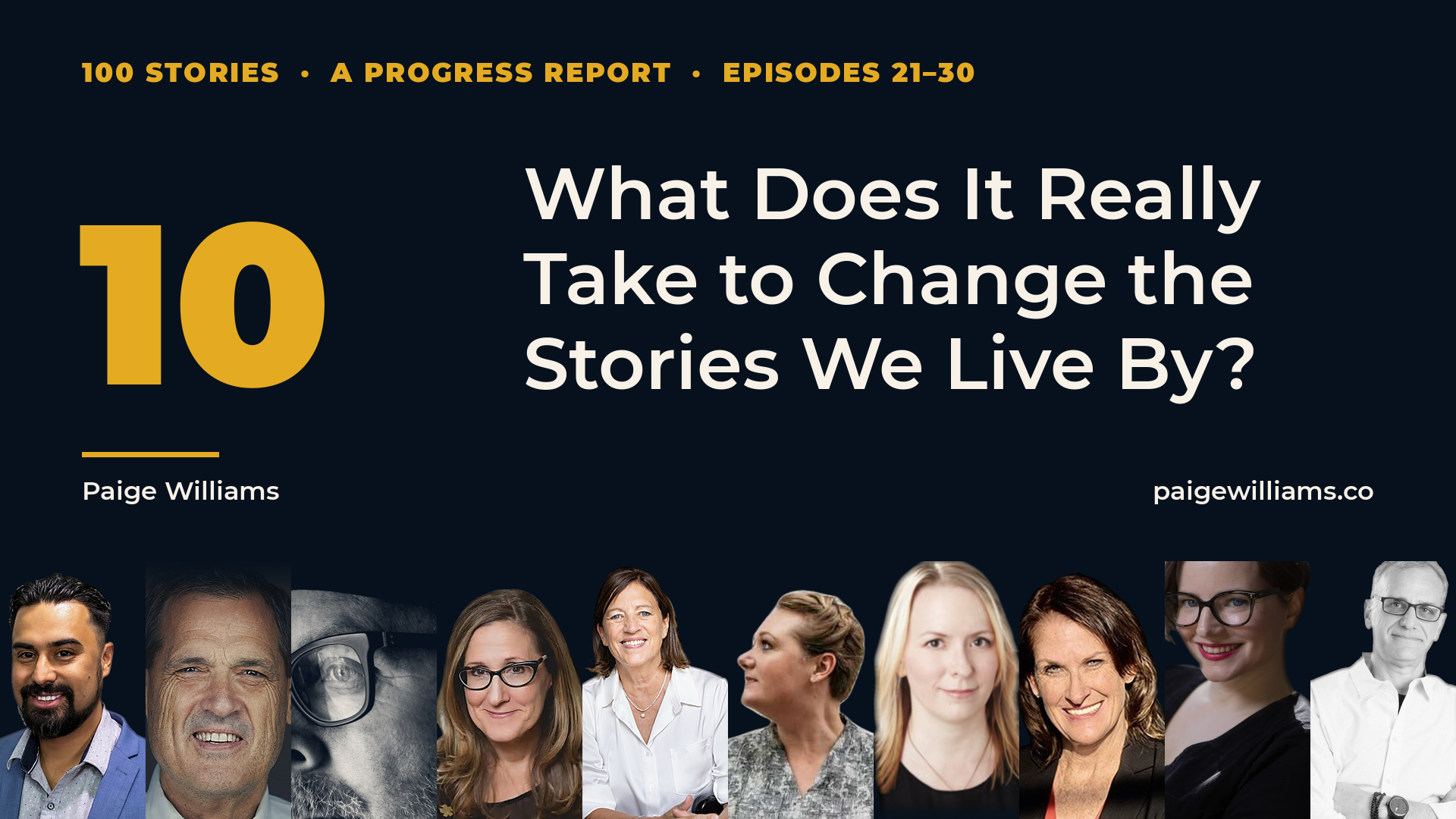
Episodes 21 through 30 brought a filmmaker from Albuquerque, the founder of narrative coaching, a studio marketing executive, a recovering lawyer turned actor, a math education professor, a ghostwriter who has written 23 books, a qualitative researcher, a former spy, a comedy director, and an executive coach who has been in psychoanalysis for 34 years. I asked each of them the same core questions. How malleable are the stories we live by, and what does it take to change one?
What came back was not agreement, and I am glad of it. Some guests told me the story has to be grieved before it can be released. Some told me the story is a commodity I should be careful not to treat as one. Two told me that what they changed about their lives was the meaning of the facts, never the facts themselves. One told me narrative intelligence is simply what human intelligence is. Another told me it may be too narrow a name.
Below are the ideas that moved me, organized by what they did to my thinking, followed by one key moment from each guest and ten definitions of narrative intelligence in their own words. I started this project with five proposed capacities. Those capacities survived these ten conversations. The way I hold them did not.
Lesson one: a score is a fixed story, and I was handing people one
Jo Boaler (episode 25) has spent her career studying what happens when a child internalizes "I'm not a math person." She watched that sentence travel from a classroom experience into a belief about ability, then intelligence, then identity. When I told her I had built a Narrative Quotient and was giving people a number, she did not hesitate. "That would be terrible to score somebody on their narrative intelligence. I wouldn't like my narrative intelligence measured by someone else."
She also told me something about the history of IQ testing I had not known: in her account, it was taken up early on by people who wanted to prove one race superior to another. Ranking, she said, is woven into how we think about learning, and the people who want children sorted into fixed tracks are the same people who came after her work on equitable math classrooms. I said on tape that I would remove the overall score, and it is gone from the NQ assessment. The questions stay, the five proposed capacities stay, the inquiry stays.
David Drake (episode 22) had said something adjacent a few conversations earlier, before I was ready to hear it. He has watched dozens of new intelligences get named and then lost in the shuffle, and he asked me what I was actually trying to measure. "I would use it more as an engine than a destination."
Jo also drew a distinction I keep returning to. Journalists and political operators who put her face on television understand the power of narrative and use it. She would not call that intelligence. She suggested a separate term, narrative misinformation, for using story to move people toward something false or harmful. The question of whether narrative intelligence carries goodness inside it, or is a neutral skill, ran through the rest of these ten conversations.
Lesson two: understanding a story is not the same as being free of it
I ran my five capacities past David Drake, who has practiced narrative coaching for 30 years, and asked what was missing. He agreed with all five and then named a thing I had been circling without seeing. Before a person can move into a new story, they have to reckon with what the old one cost them. "Every story that you've got tucked away that we're holding on to is energy that you can't use to achieve and be what you want to be in your life right now."
He told me transformation is rare and the word is thrown around like bubblegum. His Sunday school teacher, Mrs. Akita, picked a shy boy to speak in front of the whole church. He did not become a different person. What changed was the range of choices he could allow himself to see. He also told me about a friend who went to town on him over a missed diary entry, and what he eventually said to her: you were not angry at what happened, you were angry at the story you made up about what happened. All stories are fiction, he said. Some are closer to the truth than others.
Jerry Colonna (episode 30) came at the same problem through Buddhism. A man is shot with a poisoned arrow and, rather than pulling it out, spends his remaining time asking who shot it and why it always happens to him. Jerry's famous question, how have I been complicit in creating the conditions I say I don't want, has traveled the world, and he is tired of watching people turn it into a weapon against themselves.
"The point is curiosity. The point is curiosity, which then leads to agency, which is a form of adulthood." He described the fear that keeps the old story in place. If I open that closet, everything I shoved in there will fall on me. So examine the story, he said, acknowledge that you built it to stay safe, congratulate the eight-year-old who figured out how to survive, and let it go. The move that traps us is tidying it all up and putting it back. He offered three needs underneath nearly every story a person refuses to drop: love, safety, belonging. Safety wins. And then the line that rearranged something for me: if it's not safe, it's not love.
What these two men gave me together is a correction to the way I had been using the word "change." Agency may begin with grief.
Lesson three: my story about myself is only one of the stories in the room
I have spent much of this project on the internal narrative. Three guests pulled me outward.
Pam Sherman (episode 24) calls it the believability gap: the distance between who we fundamentally think we are and how we think we are supposed to show up for others, and a second gap between how we think we are showing up and how people actually experience us. She lived it in an ill-fitting lawyer's suit with shoulder pads, lying on her office floor crying at the ceiling, until a partner who moonlighted as a folk singer told her to go see a show. She auditioned. Her law firm later closed, and she walked out holding a stolen stapler and became a working actor.
She has a beef with the word authenticity. Authenticity, she said, is about you. Believability is about who you are for and with others, and she sees authenticity used as a bludgeon by leaders who insist on being exactly who they are regardless of the people in front of them. "It's not the obituary I want read. It's the story I want told tomorrow about how I showed up today."
Jeremy Sauter (episode 23) markets movies for Paramount Pictures, and he described a problem I now see everywhere. A filmmaker makes one story. A test audience perceives another. Marketing has to construct a third that puts people in seats. In a perfect world the three align; they never fully do. His ethical line is simple: don't sell a movie for what it's not. His best research instrument was a colleague who paid the pizza delivery guy twenty dollars to watch trailers and start over if the pizza guy did not like them. "We should never forget that it's not to convince us, it's to convince someone else. And it might be the pizza guy."
Farrah Bostic (episode 27) listens to people for a living, and she told her clients something I want on a wall: you hire me, but I actually work for your customer. She traced how a story about an entire generation, millennials as the next greatest generation, was built from op-eds and a survey of high school students in McLean, Virginia, one of the wealthiest towns in America. When the generation failed to live up to the prophecy, the culture decided it was their fault. Generational narratives, she said, are astrology for marketers. "A brand is a story we all know, and until it is a story we all know, it's not a brand yet."
Together these three moved something in the framework for me. The capacities may be personal, but the stories are shared, and a person who only audits their inner narrative is reading half the script.
Lesson four: flexibility without discernment is just drift
If every interpretation were equally valid, narrative intelligence would be a parlor trick. Three guests showed me what discernment looks like under pressure.
Rachel Catherine Allen (episode 26) grew up in a small Appalachian town, raised in a tiny Christian school to be, in her words, the spearhead of a culture change that would turn America back to Jesus. She journaled every day from age nine, and those pages were the one place she could ask whether the story she was being handed made sense. She went no contact with her family at 22. In a cheap flat in London she found herself crouched on the floor, stroking the baseboards, trying to work out whether she knew what reality was.
"I decided that I would trust my perception of pain. And that I knew when something hurt and that I knew that I didn't like it." She rebuilt from that one brick. Today she can see her parents with compassion, believes they loved her, and still will not let them back in, because the world they live in is so different from hers that something they experience as loving could be threatening in hers. Compassion, I learned from her, is not the same thing as access. She has also been, by her count, five hundred people, and she does not seem interested in a final version.
Her story also carries a warning for this project. Before Rachel could examine the narrative she was handed, she needed something more basic: the ability to recognize her own experience as real. I need to be careful about asking people to question their stories when someone else has already spent years undermining their ability to trust themselves. The capacity may depend on conditions that come before reflection, and safety is the first of them.
Farrah Bostic gave me the research version of the same lesson. In a Tokyo focus group for Microsoft, the transcripts read as a warning: no one has ever been funny in this category before. In the room, people were laughing, touching the ads, looking at each other. She fought her clients on it. "You need to not read the transcripts. You need to go watch the video. If you just turn off the sound and watch them, you will see something different."
That is also her critique of AI in research. The machine summarizes the summaries. It returns the consensus and misses the outlier. It does not know how many of her respondents cried. A woman in Wisconsin lost teeth during pregnancy, could not afford dental surgery, was prescribed opioids, became addicted, crossed a county line without realizing it, and went to prison, where she finally got the surgery. No survey question reaches that. The AI, Farrah said, is never going to sit down and say, tell me your whole story. Her shorthand for the machine: if you don't know, fill in C.
Meegan Kriley-Mackay (episode 28) spent 20 years in intelligence work and was trained as an interrogator at Quantico. The first three weeks of that training she spent being interrogated. What she took from the remaining seven is what she now teaches as soft interrogation, and its three rules are almost embarrassingly humane: lead with your heart, listen actively, ask open-ended questions. "When people are told what to do, they shut down. When they are threatened or intimidated, tortured, coerced, or commanded, they will lie or die to protect those they love."
Truth, in her experience, arrives through safety and curiosity, and it shows in the eyes before it shows in the words. Her father, Jim Kriley, was my mentor in graduate school, and he raised her on two-hour dinners of open-ended questions. She did not know until high school that every family did not eat that way.
Meegan's craft also carries the sharpest version of the ethical question in this stretch. Listening, empathy, and an open question can serve the person across the table, and the same skills were taught to her so she could get information from people who did not want to give it. Understanding someone's story is a form of power. The test I take from her is whether that understanding is used with the other person's knowledge, dignity, and agency intact.
Lesson five: the facts can stay the same and the story can still change
Two filmmakers, working from opposite ends of the business, taught me the same thing about meaning.
Julian Nunez (episode 21) won awards on my old platform, AudPop, and stayed in New Mexico when every classmate left for Los Angeles. He is making a Western about Paulita Maxwell, the daughter of the largest landowner in the United States in the 1800s, with Billy the Kid as a side character. Hollywood, he said, has never once let Billy speak the fluent Spanish he actually spoke. When Julian reached out to Paulita's descendants, they told him the rumors about her and Billy had plagued the family for a century and a half, and they hated the version he had assembled from dime novels and blogs. Then they pulled out photo albums going back to the 1800s and sat in on his table read.
"As a storyteller, we take the little bits of truth and history and then we make it into an entertaining story while still being able to evoke feelings from people." He rewrote the script with what the family gave him. He also made a short about immigration a few years ago and then watched the news catch up to it, character for character. On who holds the power to tell a story, his answer was that everyone has it, but not everyone can do it well, and not everyone is brave enough.
Ryan Cunningham (episode 29) has worked on Broad City and Inside Amy Schumer and directed the feature Lone Wolves. Her transformational moment was a diagnosis. After being told she has ADHD, she stopped calling herself names for failing to answer emails and started being, in her words, so much kinder to herself. "Nothing about the facts of my past changed, but the meaning of my past changed as I get older and I look at the story of my life."
She received a twenty-page neuropsych report on her autistic daughter and said the same thing about that: it reframed every struggle that came before it. She runs her film sets by leading a meditation on day one, and she believes comedy is the most effective form of social change because when you laugh you become vulnerable and open your heart to truth. The difference between whether a joke lands, she said, can be five frames in an edit.
She also gave me a line that may belong in the framework's definition of discernment. Narrative intelligence includes knowing when not to make something into a story.
Ten guests, ten moments
21. Julian Nunez, filmmaker, Albuquerque. The descendants of the real woman in his Western told him his script got her wrong, then opened their family albums and gave him their blessing. "I think everyone has the power to tell a story, but not everyone can do it correctly and not everyone is brave enough to do it."
22. David Drake, founder of the Moment Institute, creator of narrative coaching. At a threshold retreat, a woman stepped into the next phase of her life because of a sentence she heard a woman in the circle say. Every woman in the room was asked. None of them had said it. "All stories are fiction. Some are closer to the truth than others, but they're all fiction. They're all malleable."
23. Jeremy Sauter, Paramount Pictures marketing. After a year abroad without understanding the billboards, he stood at a gas pump in Missoula being shouted at by a screen and decided to make his life more like a museum, where he chooses what deserves his attention. "Our storytelling superpower is that we can take little grains of sand and form them into a beautiful glass vase of an idea."
24. Pam Sherman, actor, leadership consultant, recovering lawyer, author of Play You: The Role of a Lifetime. Her parents' gravestones read "I had such a good time" and "I did too." She and her brother-in-law wrote them. "Authenticity can be used as a bludgeon, and we're seeing it in so many of our leaders today."
25. Jo Boaler, Stanford professor, co-founder of youcubed, author of Limitless Mind. One Friday night her inbox filled with thousands of abusive messages; her sister texted a link to Tucker Carlson showing her photograph. Stanford police added her house to their patrols. She says swimming every morning is what got her through. "There's all these things that happen to us in the world. And then there's our response. And in between the two, there's actually our mind."
26. Rachel Catherine Allen, author of 23 books, founder of Bolt from the Blue Copywriting. She landed in Hong Kong at 22 with two hundred dollars and no work visa, Googled how to make money online, and was paid $3.25 for her first piece of copywriting. "Nothing is welded into the rebar of the universe. If you don't like something, you can do something else."
27. Farrah Bostic, The Difference Engine, host of Cross Tabs. In therapy she realized the boyfriends she thought were different all shared one family story, and she had been dating the same man for years. "It's not necessarily that they're untrue, but it's that they are not the only story we could be living in."
28. Meegan Kriley-Mackay, former intelligence officer, author of Leadership in the Age of AI: Rebooting Human Intelligence. In 2008 she lay on a cold concrete prison floor wondering if she would die. She had chosen to be there; interrogation was part of her spy training. "You are part of where you come from. And it's part of you, good, bad, and different. But that's in the past. Who do you want to be today?"
29. Ryan Cunningham, writer, director, producer, dramaturg, meditation teacher. Walking her set in Kentucky, she realized production is an ADHD-friendly job and that roughly eighty percent of her crew likely had it. After turning 40 she stopped waiting for permission and directed Lone Wolves on a $25,000 grant. "The goal is not to remove the complexity, it's not to simplify, but it's to create a structure that's strong enough to hold that complexity."
30. Jerry Colonna, founder of Reboot, author of Reboot. On February 2, 2002, outside Ground Zero, he chose to stay alive and called his analyst instead. Within a few years he had left JP Morgan and become a coach. "Carl Jung once said, I am not what has happened to me, I am what I choose to become. That's it. Right there."
How ten guests described narrative intelligence
I ask every guest how they would define narrative intelligence if they were writing the book. Some entries below are verbatim and some are close paraphrases of a longer answer.
Julian Nunez: "Knowing the power that a story has, and knowing how that could be used as a tool to connect with people."
David Drake: having strong rudders while staying flexible enough to shift stories when confronted with new information, recognizing your role in your own stories, retiring the ones that no longer serve you, and holding other people's stories with a certain softness.
Jeremy Sauter: "How you take all these disparate pieces of information you get and turn it into one larger singular idea that has a story or flow." The internal version, which he finds more fascinating than the external one.
Pam Sherman: built on emotional intelligence. "You've got the baseline emotional intelligence, but then what are the stories I'm going to build about myself around that? How can I make my narrative both useful for me but useful for others?"
Jo Boaler: "People who are really in touch with their own story, who've done that deeper work to work out who are you as a person, what drives you, what do you need, what is your story really about."
Rachel Catherine Allen: "The ability to be aware of your own narrative and the narratives of those around you and to actively shape your story."
Farrah Bostic: "Narrative intelligence is, in my view, actual human intelligence." Every experience is narrated by a brain that is a stowaway in the body, so the only thing that matters is the story. Her caution: we can get stuck in stories that are not the only ones available to us.
Meegan Kriley-Mackay: "Where you are at this place in your life and how you tell that story, not only internally, but more importantly, externally." A piece of what she calls human intelligence.
Ryan Cunningham: "Understanding the difference between what happened and the story that we've all constructed about what happened," and building a structure strong enough to hold the complexity rather than simplifying it away.
Jerry Colonna: "The ability to distinguish yourself from your story. You are not your story." And: "Being able to realize that you have been living somebody else's story."
Two things stand out when they sit side by side. Not one of them defined it as skill at telling stories. And the three who have spent the longest helping other people change, David, Jerry, and Pam, each placed something ethical inside the definition: softness, compassion, usefulness to others.
What these ten taught me, and how to use it for good
The question I carried into episode 21 was whether narrative intelligence has goodness built into it or is a neutral skill that a propagandist can hold as well as a healer. I leave episode 30 with a working test rather than an answer, and it came from David Drake's story about Mrs. Akita. He did not become a different boy when she chose him to speak. The universe of choices he could see got larger. Across these ten conversations, every example of story used well widened someone's range of choices, and every example of story used badly narrowed it.
Julian's film got better and more true when the family was invited to the table read. Jeremy's marketing worked when the trailer showed people a movie they would actually love, and movies died when audiences felt tricked. Meegan got the truth out of people when she stopped commanding them and started asking. Jo's attackers used her name and photograph to shrink who she was allowed to be, and she had to do the work of becoming larger than the version they made. Rachel's parents handed her a single story and she left to find out how many she could live. Jerry watched a coach at his boot camp answer the question, who would you be without the story of who you are, and discover she had been living inside a gender assigned to her as a child.
A second pattern sits underneath that one. Each of the five proposed capacities showed up in these conversations as something a person does, and also as something their conditions allow. Recognition is shaped by safety. Discernment is shaped by access to information. Flexibility is shaped by which perspectives are available to you. Agency is shaped by the real opportunities and constraints in front of you. Enactment is shaped by the environments you have to go back and live in. The capacities are personal; the conditions for them are not.
So the test I am now using, and offering as a proposed addition to the framework, is this: a use of narrative is intelligent to the degree that it leaves the people inside the story with more real choices than they had before. Narrative misinformation, Jo's term, does the opposite. It is skilled, it moves people, and it removes options while making them feel like they chose. Whether that makes an evil genius narratively intelligent and unethical, or whether something essential to intelligence goes missing when story is used that way, I do not know yet. The question I want to keep investigating is whether a given use of narrative expands people's capacity for accurate understanding and real choice, or constrains it.
Toward yourself
Treat Jerry's question as curiosity, never as a verdict. Ask what the old story was protecting, love, safety, or belonging, and thank the child who built it. Then do David's work and name what it cost you, because without that you will be pulled back into the same interpretation after you understand it perfectly. Rachel's version is simpler: notice when the pen is in your hand.
Toward the people you lead and love
Pam's believability gap is a leadership instrument. Your story about who you are is one input; how your team actually experiences you is another; the gap between them is yours to close, and you cannot close it by insisting on your authenticity. Meegan's three rules, lead with your heart, listen, ask open questions, are what it looks like to help someone else's story surface instead of installing yours over it. Parker Palmer's line, via Jerry, is the warning: if you choose to live an unexamined life, please don't take a job that involves other people.
Toward customers, audiences, and the public
Jeremy's rule holds beyond movies. Don't sell a thing for what it's not, and build the kind of process where a pizza guy can tell you you're wrong. Farrah's rule holds too: you work for the people at the other end of the story, and your job is to persuade whoever hired you to listen to them. When a narrative about a whole generation, a whole school district, or a whole electorate shows up tidy and consistent with a hook, ask what it was built from and who benefits if it sticks.
Toward the machines
Three guests raised questions about AI that challenged my thinking. Farrah's summary is that it fills in C when it does not know, returns the consensus, and cannot tell how many people in the room cried. Meegan's is that human intelligence needs to be in the room every time artificial intelligence is discussed, and that we should be asking who is writing the narrative the models learn from. Jeremy does not want a world programmed to be perfect; he wants the song he thought he hated to come on the radio. The practical instruction, for anyone using these tools to make sense of other people, is to watch the video.
One limit, one change
One limit has to be stated plainly. Material circumstances are real. Injustice, illness, economic constraint, and institutional power do not dissolve when a person reinterprets them, and a woman in Wisconsin did not lose her teeth because of a story. Some situations call for examining the narrative. Some call for changing the conditions. Most of the ones I heard about in these ten episodes called for both, and a framework that only addresses the first half would be a way of blaming people for the second.
What changes in the framework after these ten: the five proposed capacities stay. Compassion stays beneath them as the stance. And I am adding a question to the Power column of the research architecture, where it belongs: does this use of story widen or narrow the choices of the people living inside it? That question is testable in a classroom, a marketing meeting, a coaching session, and a newsroom, and I intend to keep asking it of the next seventy guests.
These are emerging interpretations drawn from ten qualitative conversations. They are not validation of the framework, and the next seventy guests may undo any of them.
The question I am carrying into episode 31 is Jerry's, turned toward this project. Who would narrative intelligence be without the story I have been telling about it?
A use of narrative is intelligent to the degree that it leaves the people inside the story with more real choices than they had before.
Continue
More research notes.
100 Stories Insights
What Twenty Conversations Have Taught Me About Narrative Intelligence
A progress report from 100 Stories: what has held up in the Narrative Intelligence framework, what has been complicated, and what hasn’t held up at all.
Story Awareness
The story choosing for you
Why awareness—not better storytelling—is the first capacity of Narrative Intelligence.
Listen & Watch
100 Stories
Join the conversations exploring story, identity, and human agency.
Subscribe, follow along, and share a conversation that resonates with you.